The Adoption Gap
Innovation is shipping faster than customers can absorb. Partners who help them cut through the noise will own the next decade.
Here's the uncomfortable truth about enterprise tech right now: your customers are drowning.
New models every quarter. Agentic frameworks every month. Product launches every week. Feature drops every day. The pace of innovation—especially in AI—has become relentless. And while vendors celebrate each launch with breathless blog posts and LinkedIn carousels, their customers are sitting in conference rooms asking the same question: "What are we actually supposed to do with all of this?"
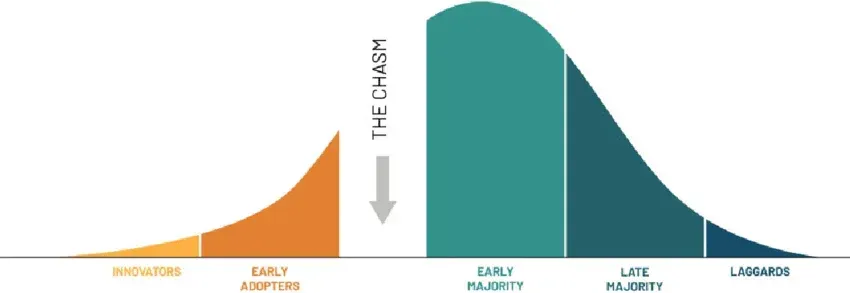
This is the Adoption Gap. The widening space between what's possible and what customers can realistically absorb, implement, and get value from. And it's growing fast.
The Problem Is Not Awareness
Let's be clear: customers know the new stuff exists. They've seen the demos. They've read the announcements. Their CEO forwarded them an article about agents at 6am. Awareness is not the bottleneck.
The bottleneck is capacity. Capacity to evaluate. Capacity to prioritize. Capacity to implement. Capacity to train people. Capacity to change how they work.
Most enterprise teams are still trying to get value from the thing they bought last year. And now you're telling them there are three new things they need to evaluate? They're not excited. They're exhausted.
Why This Is a Massive Opportunity for Partners
If you're a services partner, a systems integrator, a consultancy, or a VAR—this is your moment. Because the Adoption Gap doesn't close itself. Vendors can't close it alone. They're too busy shipping. And customers can't close it alone. They don't have the bandwidth or the specialized expertise.
Partners are the bridge.
But only if you stop acting like a reseller and start acting like a trusted advisor. The partners who win in this environment won't be the ones pushing the latest product. They'll be the ones who walk into a room and say: "Here's what you should ignore."
That takes courage. It also takes a fundamentally different value proposition.
What Customers Actually Need Right Now
1. Ruthless prioritization
Customers don't need a partner who shows up with a menu of 30 things they could do. They need someone who understands their business well enough to say: "Here are the three things that will actually move the needle this quarter. Everything else can wait." This is harder than it sounds. It requires deep knowledge of the customer's operations, their competitive pressures, and their team's maturity. But it's the single most valuable thing a partner can deliver right now.
2. ROI extraction from existing investments
Before chasing the next shiny thing, help customers get full value from what they've already bought. Most enterprise software is dramatically underutilized. Features go untouched. Integrations go unbuilt. Workflows stay manual. A partner who can walk in and say "you're paying for X but only using 30% of it—here's how we close that gap" is worth their weight in gold.
3. Scalable change management
Technology adoption is a people problem, not a technology problem. New tools fail not because they don't work, but because nobody changed how they work. Partners who build repeatable change management programs—communication plans, training curricula, adoption milestones, feedback loops—will dramatically outperform those who just do "implementation and go-live."
4. Training and enablement programs
Not a one-time webinar. Not a PDF guide nobody reads. Real, ongoing enablement that meets people where they are. Hands-on workshops. Role-specific training paths. Certification programs. Office hours. The partners who invest in building genuine training capabilities will create stickier customer relationships than any contract clause ever could.
5. Internal champion development
Every successful technology rollout has an internal champion—someone inside the customer's organization who fights for adoption when the partner isn't in the room. Smart partners don't just hope champions appear. They deliberately identify, equip, and support them. Give them the data to make the case internally. Give them the talking points for skeptical leadership. Make them look like heroes.
6. Use case discovery and roadmapping
Customers often know they need "AI" or "automation" but can't articulate where to start. Partners who run structured discovery workshops—mapping business processes, identifying friction points, and prioritizing use cases by impact and feasibility—provide enormous value before a single line of code is written.
7. Integration and workflow architecture
The average enterprise runs hundreds of SaaS tools. The value isn't in any single product—it's in how they connect. Partners who can design and build integration architectures that make data flow across systems, eliminate swivel-chair processes, and create unified workflows are solving one of the biggest pain points in enterprise tech.
8. Governance and AI readiness frameworks
As AI capabilities accelerate, customers need guardrails before they need features. Data governance. Responsible AI policies. Security reviews. Compliance frameworks. Partners who help customers build these foundations—before they start deploying agents and models everywhere—are providing the kind of strategic value that cements long-term relationships.
9. Outcome measurement and reporting
If you can't measure it, it didn't happen. Partners should be building dashboards and reporting frameworks that tie technology adoption to business outcomes. Not vanity metrics like "logins" or "seats provisioned"—real outcomes like time saved, revenue influenced, error rates reduced, customer satisfaction improved. When you can show the CFO a chart that proves ROI, you've earned the next project.
10. Managed services and continuous optimization
Go-live is not the finish line. The best partners offer ongoing managed services that continuously optimize configurations, identify new use cases, and keep adoption on track. This creates recurring revenue for the partner and sustained value for the customer. It's the ultimate win-win.
The Shift in Mindset
Here's the fundamental shift: the most valuable thing a partner can do right now is not to add more. It's to simplify.
Customers are not looking for someone to make their world more complex. They're looking for someone to make it more clear. To cut through the noise. To tell them what matters and what doesn't. To help them move faster by doing less.
| What Partners Used to Do | What Partners Need to Do Now |
|---|---|
| Resell products | Curate and prioritize solutions |
| Implement and hand off | Implement, train, and stay |
| Respond to RFPs | Proactively identify use cases |
| Sell features | Deliver outcomes |
| Chase new logos | Deepen existing relationships |
| Demo the latest release | Filter out the noise |
The Bottom Line
The Adoption Gap is real, it's growing, and it's not going away. If anything, the pace of innovation is accelerating. Every major platform is shipping faster than ever. AI is compressing product cycles from years to months.
Customers need partners more than ever. Not to sell them more stuff—but to help them actually use the stuff they have. To prioritize ruthlessly. To build the organizational muscle for continuous change. To turn technology investments into business outcomes.
The partners who close the Adoption Gap will be indispensable. The ones who keep widening it—by pushing more products without driving adoption—will be replaced.
"The essence of strategy is choosing what not to do." — Porter
If you enjoyed this piece, please share it. Thanks. 🙏